ShareP is now part of Stellos →
Stellos.com
Renting out company parking spaces in Switzerland
Short answer: yes. A company in Switzerland can rent out its own parking spaces to other companies, residents or visitors, for example in the evening, at night and at weekends when its own staff do not need them. Before you start, check five things: the building permit and local parking rules, VAT, tax on the income, the contract with drivers, and your liability insurance. Access, booking and payment can then run without keys and without staff on site.
When it makes sense
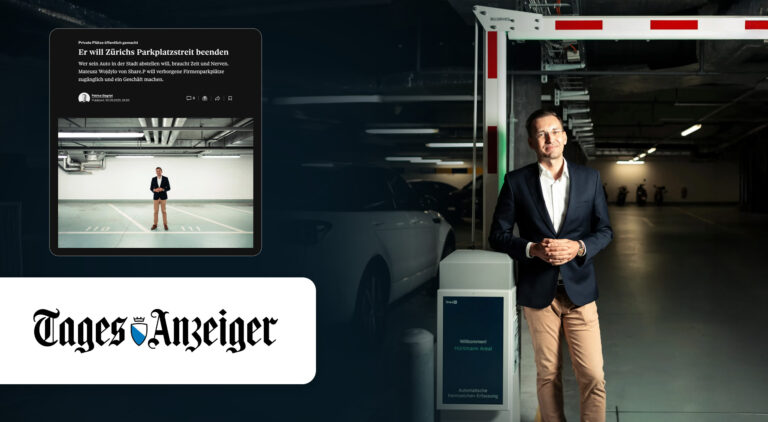
Office car parks are full during working hours and largely empty in the evening and at weekends. Residents nearby, commuters and visitors to shops, hotels or events look for exactly those spaces at exactly those times. Cities support this: the canton of Basel-Stadt runs a programme for the multiple use of private parking spaces, in which companies make their spaces available to residents and commuters outside business hours (Kanton Basel-Stadt). In Zürich, company car parks are already rented out to the public at weekends (Tages-Anzeiger, 30.09.2025).
Your own employees keep their spaces: you decide which spaces are offered and in which hours.
1. Permit and local parking rules
Parking spaces are part of a building permit. In the canton of Zürich the number of spaces a building must have is set by § 243 of the Planning and Building Act and by each municipality's parking ordinance; in the City of Zürich the civil engineering office checks the minimum and maximum permitted number of spaces as part of the building permit procedure (Stadt Zürich). Whether opening existing spaces to the public counts as a change of use depends on the municipality and on how the spaces were approved. Ask your municipality's building authority in writing before you start. In Basel, the canton's programme exists precisely to make this possible.
2. VAT
Renting out parking spaces is in principle subject to Swiss VAT at the standard rate of 8.1%. It is exempt only for spaces in public use, or when the parking space is a dependent ancillary service to an exempt rental of property, for example a flat let by the same landlord to the same tenant (WEKA). Short-term rentals to the public are not such an ancillary service. If your company is registered for VAT, invoice the rentals with VAT; check the details with your tax adviser or the Federal Tax Administration.
3. Tax on the income
For a company, parking income is part of taxable profit. Costs connected with the rental, such as maintenance, lighting or the access system, reduce it.
4. Contract and conditions
A parking rental is a lease under articles 253 ff. of the Swiss Code of Obligations. The landlord must hand over the space in a usable condition and keep it so (art. 256 CO) (WEKA). For short-term parking the contract is the booking itself, so the conditions must say clearly: price, hours, who may use the space, what happens if a car stays longer than booked, and house rules such as height limits.
5. Liability and insurance
Ask your liability insurer in writing whether letting spaces to third parties is covered. Keep lighting, signage and the condition of the car park in order; that is your duty as landlord.
6. Access without keys
The practical problem is not the contract but the gate. Handing out cards or remote controls to strangers does not work. A camera that reads number plates, or a QR code at the gate, opens the barrier only for drivers with a valid booking and only in the hours you allow. Every entry and exit is recorded.
What you can charge
Prices depend on location. One example: at Lancy Centre in Geneva, a reserved space costs CHF 3 per hour, at most CHF 18 per day, and a monthly subscription CHF 175.
How it works with ShareP
- You tell us how many spaces you want to offer, where, and in which hours.
- We check the gate on site and fit number plate recognition or QR access where needed. The cost of any access hardware is agreed for each site before you decide.
- Together we set prices and hours. Your employees keep their spaces when they need them.
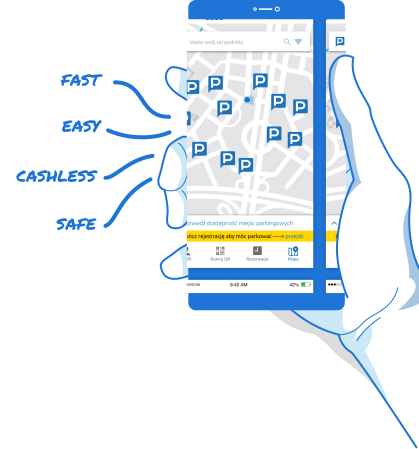
- Drivers book and pay in the ShareP app or online. Support is reachable by phone around the clock. You receive the income as agreed in your contract.
Questions to ask any platform
- Who pays for and maintains the access hardware?
- Can my employees keep fixed spaces during working hours?
- Who handles payment, VAT invoices and refunds?
- What happens when a car overstays or a space is occupied?
- Is there a support line drivers can call at night?
See more awesome stuff >>
We are in the media
Portals and newspapers about us



Our partners:
Nothing comes from nothing and that is why we asked other professionals for cooperation.

SwissProp Tech

Airportparking.ch

Interparking

OVHCloud

Orange


Innosuisse

World Tourism Forum Lucerne

PSPA/AVERE

University of Zurich
You can unsubscribe at any time



 English (UK)
  Deutsch (Schweiz)
  Español
  Français
  Українська
  Polski
  Italiano